

From Colony to Nation: Indonesia’s Long Road to Independence


Indonesia was officially a traditional extractive colony from 1800 to 1942. However, from 1602 to 1799, the Dutch East India Company initially operated as a monopoly for spices, with its central hub located in Jakarta, Indonesia. It was just convenient that the Dutch decided to rule the Dutch East Indies as a formal colony. In the mid-18th century, the Dutch had effectively expanded their influence across Java and Sumatra. Their extractive colony built roads and railways in Java and Sumatra, not for Indonesians, but for plantations, which moved sugar, coffee, and rubber to European markets.

The Dutch colonial rule was characterized by racial and class segregation, as they were locked in underdevelopment. Indonesia became a Dutch colonial dependency, with all its political and economic control falling under Dutch rule. This fits into the dependency theory[8]where the world economy is a group within two groups: the core, rich industrialized countries including the U.S., Europe, and Japan, and on the other hand, the periphery, poorer, less developed countries, including former colonies in Asia, Africa, or Latin America. The periphery is “dependent” on the core as it exports raw materials, cheap labor, or simple goods, and imports expensive manufactured products, technology, and investment. This is what contributes to Indonesia’s persistent underdevelopment, seemingly locking the country into a constant cycle of political and economic instability. The emergence of Dutch enclaves, a caste-like social hierarchy, and a well-developed Western-educated elite from the Netherlands, alongside large-scale areas of unskilled labor.
Moreover, some Dutch liberals thought that since the Netherlands felt they owed Indonesians an “honor of debt,” through the amount of money they made off of them, as said by Conrad Theodor van Deventer, a liberal Democratic member of the Parliament of the Netherlands. This belief resulted in the Ethical Policy, where financial assistance was given by the Netherlands to be devoted to bettering the health and education services, and provision of agricultural services in hopes to stimulate the growth of the economy. They planned to do this by improving education, increasing irrigation, and emigration from Java to less populated areas. On top of that, Indonesia had a strict laissez-faire policy, where it was known for its positive welfare system being funded by the metropolitan treasury. While all of this sounded good in theory, in reality, some saw this as a noble experiment to create a new class of elite within Indonesia. Others saw this as a hope for cultural immersion between Indonesian and Western cultures. In the end, neither achieved an increase in living standards nor created a revolution; however, it did provide agricultural improvements in areas of assistance and advice on irrigation techniques within pre-existing wet-rice technology in Java. Within the education sector, little came out of it, where there was a bigger opportunity for those in the primary to tertiary classes to get access to education. By the end of the 1930s, only a limited group of high school graduates had been produced, with the literacy rate being over 6%. The handful of high school graduates ended up being the only positive aspect that emerged from the Ethical Policy, despite its limitations in educational achievement. The end result was the production of a small, educated elite capable of experiencing their own frustrations with societal issues that had lost their traditional moorings, increasing local grievances.

Beyond education, Dutch colonialism brought deeper changes to the social structure of Indonesia. Traditional adat village structures, which were once cohesive and self-governing, began to be truncated under the pressures of new schooling, contract labor, and new Western ideologies. Urbanization pulled Indonesians away from the usual communal belief, leaving many of them caught between modernity and tradition. Some found themselves belonging in brotherhood groups of bandit gangs. In contrast, others turned to new organizations like scouting, which—ironically introduced by the Dutch— became a space for Indonesian youths to embrace their newfound identity. These small changes to the old social order is what created room for a new form of identity as Indonesians, laying the foundation for social movements and protests in the 1920-1930s. More awareness about issues due to the increase in educated people increased the amount of local grievances about the country.
Local grievances led to numerous pre-nationalist movements that revolved around specific discontents, including economic discrimination under colonial rule, social discrimination, and a heightened recognition of how much the Dutch pervaded their daily lives. With the emergence of a new elite, their education outpaced their employment opportunities, as they were westernized yet tied to their traditional peripheral society, which held them back. Around the time of the 1930s, the Youth Pledge was already established. The pledge allowed organizations to declare that they were united as one motherland, one nation, and one language (Bahasa Indonesia), symbolizing a shared national identity. This had led to the emergence of youth movements and unions, including Sarekat Islam, the Indonesian Communist Party (PKI), and Budi Utomo. Out of Indonesia’s four movements, the liberal, Western-oriented group, and the left side of the Islamic movement are essentially comprised of the educated elite from towns. Due to the absence of single-party discipline, it was often seen that people would belong to more than one organization, as nationalism was expressed through different tactics and beliefs. By this time, all the youth groups, also referred to as “Boy Scout groups,” began promoting unity across the island's ethnic groups. Scouts were given the privilege to teach children a way to think of themselves as Indonesians, not just Javanese, Sundanese, etc.. The Dutch didn’t like the idea of this, nevertheless, and limited political activity because of the fear of nationalism. What this did was only make leaders—including Sukarno, who was the face of Indonesia’s independence movement, Hatta, an expert in economics and law, and Sjahrir, one of the quintessential Western-educated nationalists behind democratic ideals—to keep nationalism alive underground, out of the authorities' knowledge.
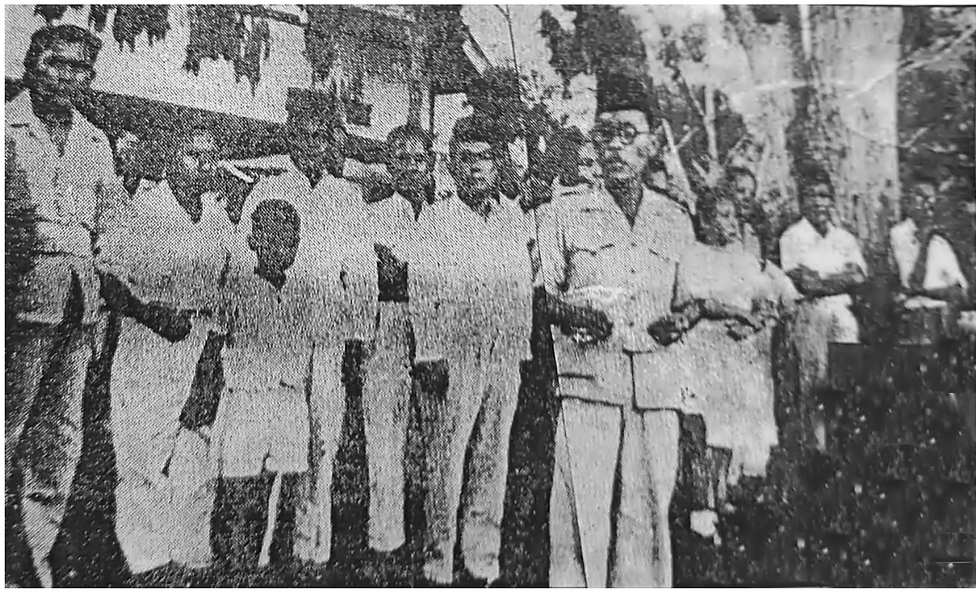
Following the underground nationalist scheme, during WWII from 1942 to 1945, Japan defeated the Dutch and occupied Indonesia[9]. Japan banned scouting and replaced the youth groups with their own youth movements, Keibodan and Seinendan, to train the growing, premature Indonesian youths for war. Young Indonesian adolescents received military training and organization from trained Indonesian leaders, and this instead led to the organization of independence fighters. Indonesian leaders taught in Bahasa Indonesia, which further promoted the language. Overall, the Japanese gave Indonesians more space to grow their own identity compared to the Dutch.
That’s when, by the end of World War II, Indonesia’s path to independence could not be stopped. When Japan surrendered in August 1945, Sukarno and Hatta seized the moment to proclaim Indonesia's independence in Jakarta on August 17. This was a bold move as the Dutch intended to reclaim their colony and returned with military force, sparking a four-year revolution that tested the unity of the new nation. What held Indonesia to victory was not just strong political leadership but a sense of identity that had been forged through the many decades of colonial repression, social change, and shared struggle under the Japanese occupation. Farmers, students, and former youth scouts turned soldiers fought side by side, and the message of Merdeka!—freedom—resonated across the islands. Although the Dutch finally recognized Indonesia’s sovereignty in 1949, the new republic inherited weak institutions, deep inequalities, and infrastructure built only for extraction. Independence brought pride and unity, but also the immense challenge of creating a nation from the ruins of colonial dependency.
Following independence in 1961, the youth nationalist groups united to form a single force, officially known as Gerakan Pramuka Indonesia. Once colonial rule ended, Indonesians became more open to using Western knowledge and technology, as they could now choose it on their own terms instead of having it imposed on them. They weren’t a fan of the abat-village society and wanted education to go towards the Western urban culture in order to create “a substantial middle class”. This movement often ended up imitating Western culture n the surface instead of truly adapting the deeper principles behind it. Their overall theme would be “political freedom means social emancipation”. However, the left-wing vision in Indonesia centered on dismantling entrenched hierarchies, pushing for social justice, greater economic equality, and ultimately a society free of rigid class divisions. They argued that revolution was incomplete until Indonesians were freed of these “constraints”. Indonesians had hoped for dramatic improvements, but the intensity of political passion led people to treat their ideas as absolute truths, making compromise and practical politics impossible. With such weak and poor infrastructures and institutions, corruption and political instability persisted post-nationalism.


Comments